
Projection-driven Disinformation on Substack
Accusation in a Mirror


I’ve started noticing a pattern.
A person writes a piece. Someone else responds, not to what was written, but to a version of it that doesn’t exist.
The response may include selective quotes stripped of context. It may include screenshots carefully cropped to remove important information. Sometimes it involves entirely fabricated screenshots. Sometimes it relies on a bizarre interpretation so detached from the original text that it borders on hallucination.
The target is then presented as racist, misogynistic, extremist, hateful, dangerous, or morally defective in some other way.
The accusation itself becomes the story.
The original work becomes irrelevant.
This isn’t a new tactic. It predates social media by centuries. Propagandists, intelligence services, political operatives, and activist movements have all used versions of it. The Soviet Union referred to many of these activities collectively as “active measures.” Intelligence agencies describe them as disinformation, black propaganda, character assassination, and false attribution.
The principle is simple.
If you cannot defeat an argument, make people afraid to be associated with the person making it.
The goal is isolation.
Why I Started Paying Attention
The reason I started paying attention to this pattern is because I became the target of a mild version of it.
Some time ago I posted a short erotic poem. Nothing political. Nothing about rights, laws, or social issues. It was plainly erotic poetry.
Another user responded by claiming the piece was misogynistic.
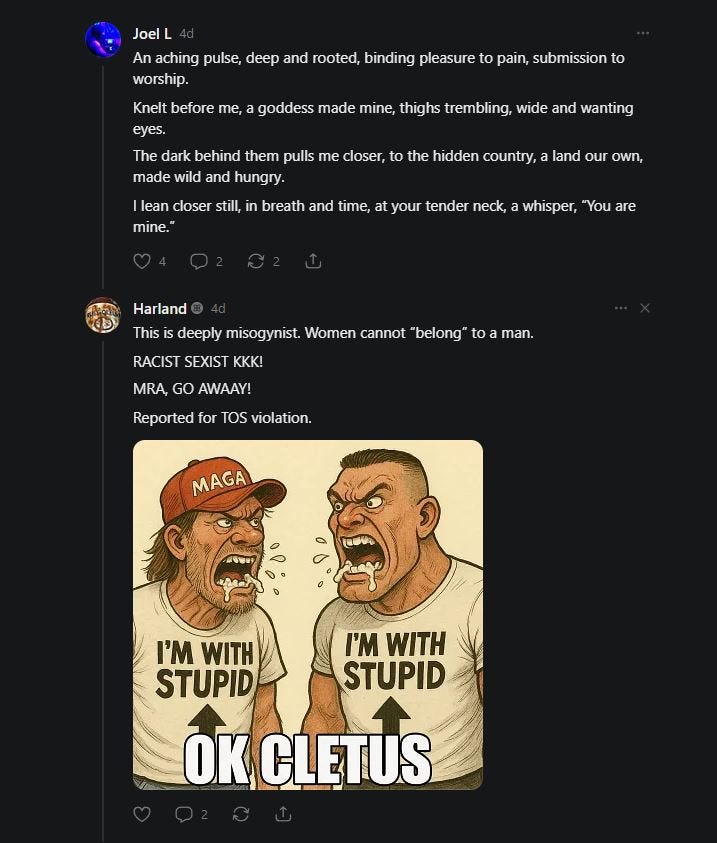
At first, I assumed they were simply misinterpreting the work. That happens. Literature is subjective. People bring their own experiences and assumptions to what they read.
But the conversation quickly moved beyond interpretation.
When I pointed out the difference between erotic fantasy and actual beliefs about human relationships, the accusation shifted. The discussion was no longer about the text itself. Instead, implications began to appear.
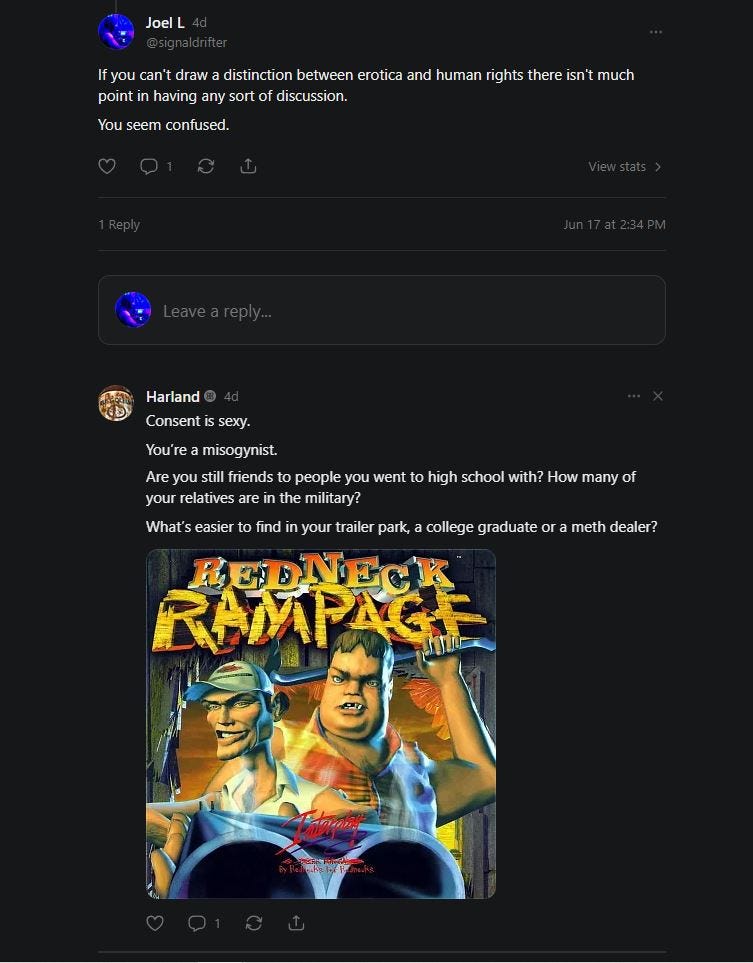
If I wrote about dominance and submissive roleplay, then perhaps I endorsed that dynamic in every facet of a relationship. If I wrote about ownership within a fictional erotic context, then perhaps I believed actual human beings could be owned. If I disagreed with the accusation, then perhaps I did not understand consent. That’s quite a leap. The argument expanded until it bore little resemblance to the original work.
What struck me was that no distinction was being allowed between depiction and endorsement.
The accusation seemed to require collapsing fiction and role-play into core beliefs.
Afterward, I looked through the user’s profile.
What I found was interesting.
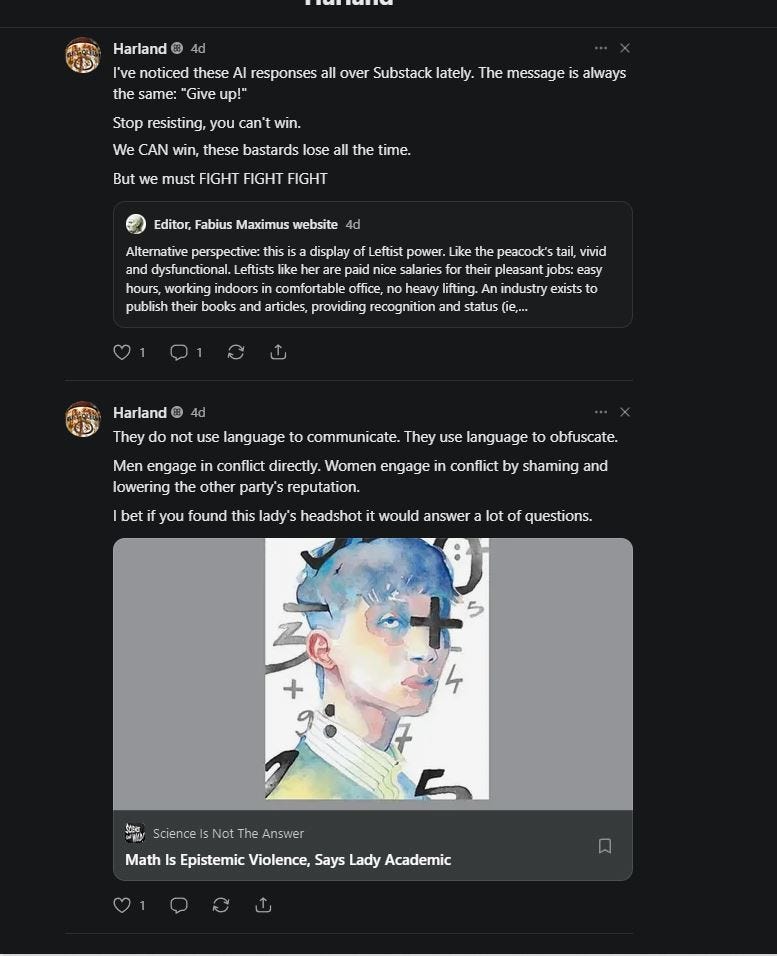
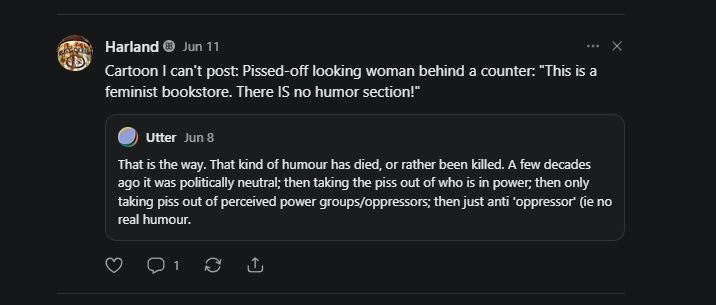
This was a misogynist accusing me of being exactly that. Bonus points for noticing the additional projection going on in the first screenshot.
The account’s activity consisted largely of comments and restacks attacking leftists and feminists, criticizing progressive politics, and expressing support for MAGA-aligned positions.
That was the first moment I began wondering whether some of these interactions were operating on a different level than ordinary disagreement.
To be clear, I do not think I am the target of a sophisticated campaign. I’m small potatoes. Maybe not even potatoes. Maybe a single slice of onion that fell under the stove. I believe this is a one off attack from a rather unhinged individual. But it serves as an example of how these tactics are used on a larger scale. And make no mistake, they are in use, right now, across all platforms, including Substack.
The Pattern begins to reveal itself
Then, today, I saw another writer describe something far more serious.
According to their account, someone had created an entirely fabricated screenshot bearing their name and profile, depicting them making openly racist remarks they had never made. The purpose was obvious. The screenshot existed to create a false association between the target and racism. It was not a disagreement with their ideas. It was an attempt to manufacture a new identity for them in the minds of observers.
Taken individually, these incidents could be dismissed as isolated acts by random people behaving badly online.
Taken together, they begin to resemble a recognizable pattern.
A successful smear operation doesn’t need to convince everyone. It only needs to create enough uncertainty that observers decide it isn’t worth the risk of engaging with the target.
Most people are not conducting forensic investigations before deciding who to follow, who to trust, or who to avoid. They are making rapid social judgments based on limited information.
The projection machine exploits this. One fabricated screenshot can spread farther than a detailed correction. One accusation can travel farther than a thousand explanations.
The people employing this tactic understand something important:
Attention is limited.
Outrage is efficient.
Verification is expensive.
The tactic often follows a predictable sequence.
Step one: identify a target.
Step two: reinterpret, distort, selectively quote, or fabricate.
Step three: attach a socially toxic label.
Step four: distribute the accusation through sympathetic networks.
Step five: force the target into a defensive position.
At this point the target is trapped. If they ignore it, observers may assume the accusation is true. If they respond, the response becomes evidence that they are defensive. If they become angry, the anger becomes proof of guilt.
The objective isn’t to win a debate, the objective is to consume the target’s time, energy, attention, credibility, and emotional resources.
The tactic becomes even more effective when combined with projection.
Groups that regularly engage in misrepresentation begin accusing others of misrepresentation. Groups that organize harassment accuse others of harassment. Groups that create false narratives accuse others of creating false narratives. Groups that endorse racist and misogynistic ideologies accuse others of doing the same.
The accusation functions as camouflage. By directing attention outward, scrutiny of their own behavior decreases. Historically this pattern appears everywhere. Political movements have forged documents to discredit opponents. Governments have manufactured stories to justify crackdowns. Intelligence services have planted fabricated evidence to create confusion and distrust.
Modern social media simply reduced the cost of deployment.
It is important to understand that this tactic is not unique to any political ideology. It appears in political movements, activist circles, extremist groups, cults, online factions, influence operations, engagement pods, and social cliques of every kind. Wherever status, belonging, and narrative control become more important than truth, the pattern emerges. In many cases, the projection becomes the signal itself. The people most aggressively accusing others of harassment are often engaged in harassment. Those obsessed with policing misinformation may be spreading it. Those constantly warning about manipulation may be attempting to manipulate. The accusation serves a dual purpose: it damages the target while drawing attention away from the accuser's own behavior. Not every accusation is projection, but when the same allegations appear again and again, untethered from evidence and disconnected from reality, it becomes worth asking whether the accusation is revealing more about the speaker than the accused.
To be clear, I do not think I am the target of a sophisticated campaign. I believe this is a one off attack from a rather unhinged individual. But it serves as an example of how these tactics are used on larger scales. And make no mistake, they are in use, right now, across all platforms, including Substack.
How to Fight Back

The question, then, is how to fight back. The first mistake is assuming facts alone will solve the problem. The attack is rarely aimed at truth. It is aimed at perception.
That means the defense is partly informational and partly psychological.
Document everything.
Archive posts.
Keep originals.
Preserve receipts.
Do not rely on platforms to do it for you.
Respond when necessary, but do so briefly and directly. Do not allow yourself to become trapped in endless circular arguments. Every hour spent defending yourself against invented claims is an hour not spent creating.
Most importantly, refuse the frame. The smear depends on forcing you into a role chosen by someone else. You do not have to occupy that role. The strongest response is often to continue producing honest work while maintaining a clear record of what actually happened.
The projection machine survives on reaction.
It feeds on outrage.
It grows through amplification.
And like most parasites, it becomes much weaker once people learn to recognize its shape.
© 2025 Joel L. All rights reserved.
Unauthorized reproduction or distribution of this material is prohibited.
If you want this work to continue, supporting it directly is the most effective way to do that.
Thanks for reading. - Joel L.
The Drift Faction Index- Available Here
Echo Rift Season One Index - All Episodes Available Here
Liminal Salvage Index - Available Here
So many trolls. It's jarring to have someone come at you like that. Thanks for sharing.
This is intense, and now you've highlighted it, the pattern is a lot more obvious. Thank you for bringing this forward, Joel. I think it's something we all need to be more vigilant of.